
Symptoms of Salivary Gland Stones (Sialolithiasis)
Symptoms of salivary gland stones (sialolithiasis) most often include pain and swelling under the jaw or in the cheek. These signs appear or get worse during meals. Which ones you notice depends on where the stone sits. It also depends on how much the stone blocks the flow of saliva.
- Main signs: pain and swelling during meals, fullness, dry mouth and a bad taste
- Symptoms also depend on where the stone is located
- The diagnosis is confirmed after an exam and testing


What Is Sialolithiasis
Sialolithiasis is also called salivary stone disease. In this condition, a hard stone forms in a salivary gland or its duct. The stone is called a sialolith. It blocks the path of saliva into the mouth, so the flow is disrupted.
Saliva moistens the mouth and aids digestion. It also protects the teeth and mucous membranes. Therefore, a disruption in its flow becomes noticeable quickly, most often during meals.
This disrupted outflow explains most symptoms of the disease. How severe they are depends on the size of the stone. It also depends on the degree of duct blockage and on inflammation. Some people have pronounced symptoms, while others have mild or intermittent ones.
Stones can form in any of the major salivary glands. However, the disease most often affects the submandibular gland. The parotid gland is affected less often. Stones in the sublingual gland are rare. You can read about why they form on the Causes of Salivary Gland Stones page.
Main Symptoms of Salivary Gland Stones
Symptoms vary from patient to patient. Some people have nearly all the signs below, while others have only one or two. Here is what people most often see a doctor about.
Pain While Eating
Pain or pressure appears in the gland during meals or shortly after. At that time, saliva production increases.
Gland Swelling
Swelling appears under the jaw or in the cheek in front of the ear. It often increases during meals. Then it gradually goes down.
A Feeling of Fullness
The gland feels full and tense. Saliva is produced, but it can't flow freely into the mouth.
Changes in Saliva Flow
Saliva flow from the duct becomes scant or difficult. Dryness may appear on one side of the mouth. An unpleasant taste is also possible.
A Sense of Obstruction
Sometimes a firm lump can be felt under the tongue or inside the cheek. In addition, a stone at the duct opening may be visible on examination.
Signs of Inflammation
Worsening pain, redness, fever and pus from the duct mean inflammation has set in. In that case, you need prompt medical attention.
Why Symptoms Are Linked to Eating
Why Pain Gets Worse During Meals
During meals, the salivary glands become more active. This also happens at the sight or smell of food. If a stone partly blocks the duct, saliva has trouble getting out. As a result, pressure builds up in the gland and causes pain and swelling. After eating, saliva production drops. Then the pressure eases, and symptoms may subside.
What Happens in the Gland When Saliva Backs Up
Saliva keeps being produced, but the stone blocks its path out. As a result, the duct above the obstruction widens and its walls stretch. The gland then increases in size. Stagnant saliva also creates a favorable environment for bacteria. This can lead to inflammation in the gland.
Why Symptoms Come and Go
When the blockage is incomplete, some saliva still gets through the duct. So flare-ups alternate with calmer periods. The absence of pain doesn’t mean the stone is gone. It can remain in the duct and flare up again later. Sometimes a stone causes no symptoms for a long time. In that case, it is only found by chance during testing.
Diagram: How a Stone Traps Saliva in the Duct


“How a stone blocks the duct and causes saliva to back up”
Salivary Colic and Symptom Severity
Sialolithiasis has some features that patients often ask about. They include what an attack feels like and how people describe their sensations. Another question is why some people have severe pain while others barely notice it.
What Is Salivary Colic
Salivary colic is an attack of pain and gland swelling. It occurs during a meal or shortly after. The pain can be sharp, and the swelling may be visible from outside. The attack subsides once saliva production returns to normal. Episodes may recur with every meal or less often. For example, sour or spicy food stimulates saliva production more strongly. Recurring attacks are a reason to get checked, even if you feel fine in between.
How Patients Describe the Sensation
Patients describe heaviness and tension under the jaw. Others mention an inner sense of fullness. Some feel pressure under the tongue or in the cheek. Sometimes they also feel a “lump” in the gland area. For some people, the only complaint is an unpleasant sensation while eating. Severe pain may be absent. This is exactly why the condition often goes unnoticed for a long time.
What Determines Severity
Severity depends on the stone's size and position in the duct. It also depends on how much the passage is blocked. Inflammation and the condition of the gland matter as well. A small stone may cause no symptoms for a long time. This is true if it doesn't fully block the duct. In contrast, a stone that blocks the duct usually produces pronounced symptoms. However, pain intensity alone can't indicate the size of the stone. Only testing can determine that.
Symptoms of Salivary Gland Stones by Stage
Sialolithiasis develops gradually, so its symptoms change over time. Doctors often describe three stages. The boundaries between them are approximate. In addition, the disease progresses differently in different patients.
Early Stage
Mild to moderate pain occurs during meals. It goes away shortly after eating. There may be no swelling, or it may be barely noticeable. Because the symptoms are mild, people often don't see a doctor. As a result, the disease continues to progress.
Clinically Apparent Stage
Pain during meals becomes stronger. Swelling appears in the gland area, and attacks of salivary colic occur. Between attacks, a person may feel fine. However, the episodes keep recurring.
Late Stage
Gland swelling may become constant. The duct may occasionally discharge pus, and some patients develop dry mouth. The gland suffers from prolonged stagnation and inflammation. Therefore, testing shouldn't be delayed at this stage.
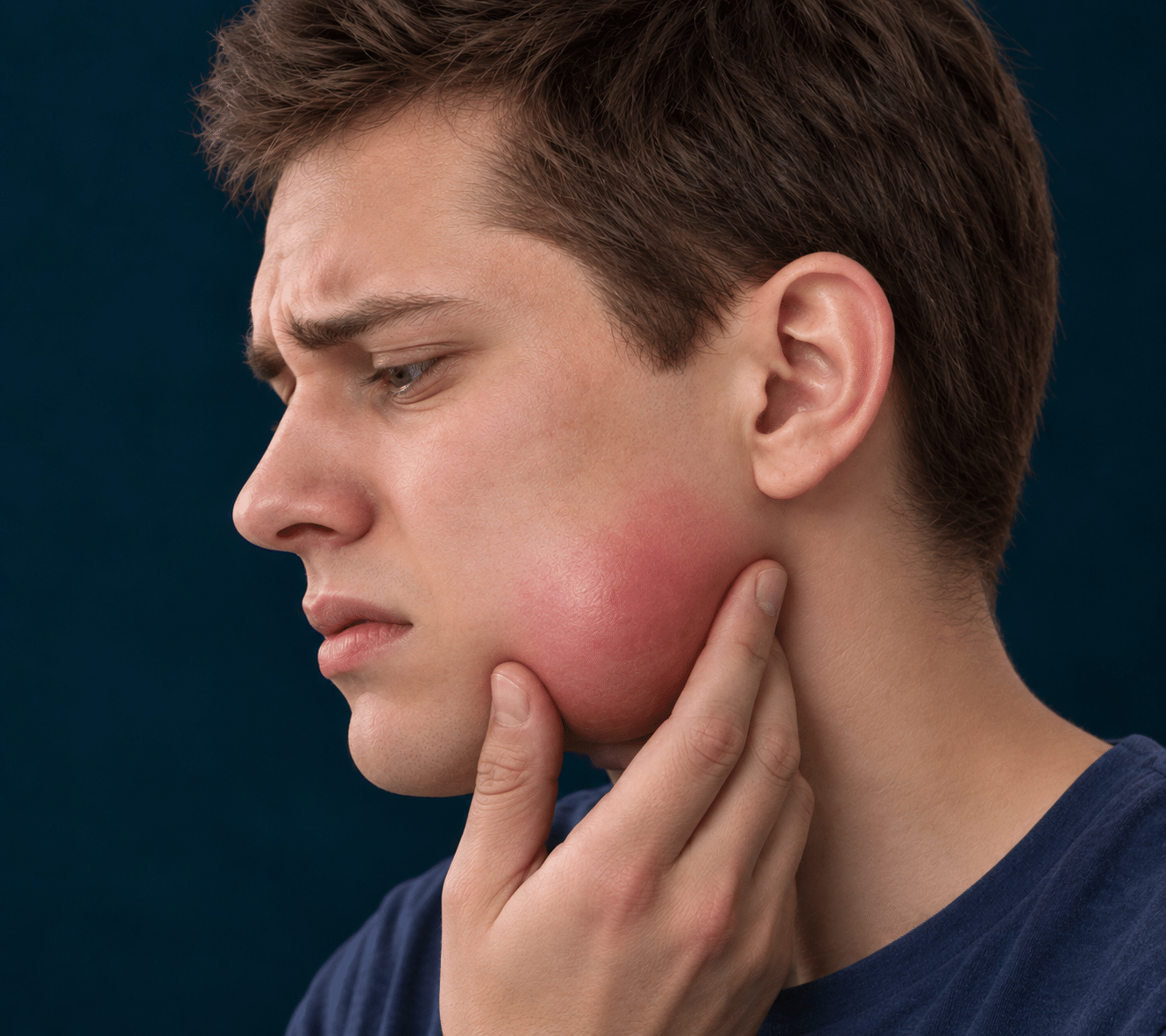
Photo: Swelling in the Salivary Gland Area
“Gland swelling is one of the main signs of sialolithiasis”
Signs of Salivary Gland Inflammation
When saliva can’t drain for long, the duct and gland favor bacterial growth. As a result, inflammation (sialadenitis) sets in.
Inflammation shows up as increasing pain that is no longer tied only to eating. The swelling becomes firm and tender. The skin over the gland turns red, and fever and weakness may appear. Cloudy saliva or pus may also discharge from the duct opening. An unpleasant taste often appears in the mouth as well.
Timing helps distinguish inflammation from an ordinary attack. With colic, pain and swelling are tied to eating and then subside. With inflammation, however, the swelling persists even between meals. The skin over the gland turns red and hot, pain increases, and weakness sets in. A doctor should always evaluate this combination of signs.
Acute inflammation can be treated. However, it tends to recur as long as the stone remains in the duct. Repeated flare-ups lead to chronic inflammation. The gland can then become firmer and produce less saliva. In rare cases, the infection spreads to surrounding tissue. This condition requires emergency care.
How Symptoms Differ by Stone Location
The doctor determines the exact location of the stone. Below is how symptoms typically differ. Each location has its own dedicated page. Symptoms usually appear on one side. However, if stones are present in several glands, symptoms can occur on both sides.
Submandibular Gland
Stones form here most often. Pain and swelling are felt under the jaw and usually worsen during meals. The swelling is sometimes visible from outside. If inflammation develops, the skin over the gland can turn red.
Stone Under the Tongue
This is a stone in the submandibular duct near its opening into the mouth. It causes fullness and tenderness at the floor of the mouth. Sometimes it can be felt as a firm nodule. Redness may also appear around the duct opening.
Parotid Gland
Swelling and pain occur in the cheek in front of the ear. They are strongest while chewing and eating. Stones in this gland are less common. Therefore, the symptoms are easily mistaken for a dental or ear problem. This makes testing especially important.
Why Symptoms Alone Aren't Enough
Similar symptoms can occur with other conditions too. Examples include gland inflammation without a stone and dental problems. Enlarged lymph nodes, a cyst, or a tumor can look similar. Symptoms alone can’t tell you whether a stone is present. They also can’t show where it is or how large it is. That requires testing. The points below are only general guidance, because causes can overlap. In the end, the doctor draws conclusions based on test results.
What Points to a Stone
Symptoms usually occur on one side, are linked to eating, and recur. Swelling increases during meals and decreases afterward. Sometimes the stone can be felt. Saliva flow from the duct is also scant.
What More Often Points to Other Causes
Pain unrelated to eating more often points to other causes. The same is true of a constant, tender lump under the skin. Dryness on both sides of the mouth also points that way. So does pain that worsens with hot or cold. These can be signs of dental problems, lymph node conditions or generalized salivary gland disorders.
How the Diagnosis Is Confirmed
What Happens During the Consultation
The doctor asks when the pain and swelling occur. Questions also cover how they relate to eating and whether there have been flare-ups. Then the doctor examines the mouth and the gland area. The doctor checks how saliva flows from the duct. If possible, the doctor also feels for the stone. Finally, you are asked about medications and chronic conditions that affect saliva production.
What Tests Are Ordered
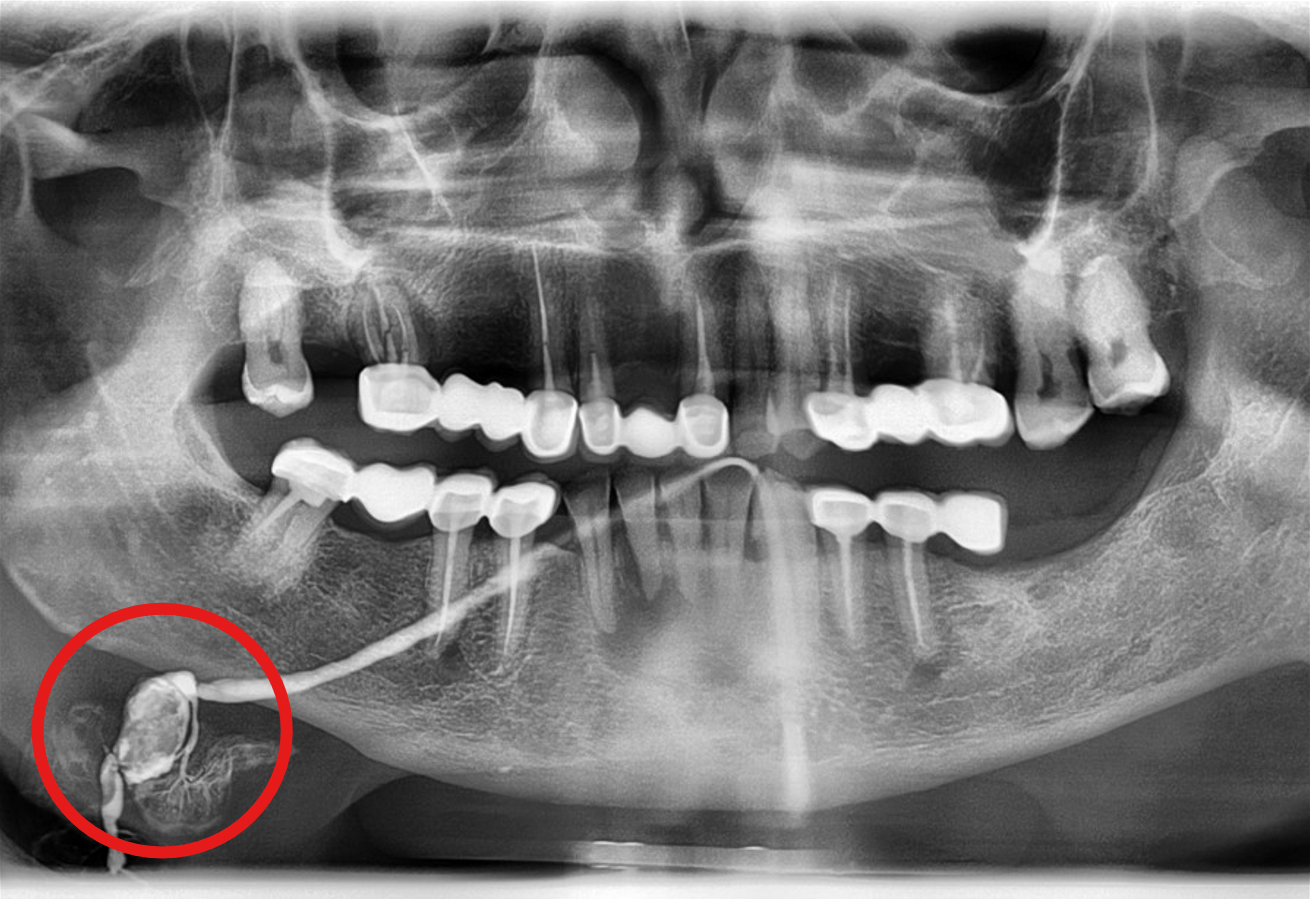
The main method is sialography. It accurately shows whether a stone is present, plus its size and location. If needed, the doctor may also order a CT scan to assess the stone’s position. Contrast sialography can check duct patency, but it is usually performed outside a flare-up. Another option is sialendoscopy, which examines the duct with a thin endoscope. Ultrasound can be done even during a flare-up. However, it does not always find the stone. Learn more on the Diagnosis and Sialendoscopy pages.
Test results show which gland and which part of the duct hold the stone. They also show its size and whether inflammation is present. Finally, they show whether the gland’s function is preserved. Treatment strategy depends on these findings. It is chosen individually, not based on symptom severity alone.

When You Should See a Doctor
Book a consultation if pain or swelling under the jaw or in the cheek recurs. This is especially true during meals. Do so even if the attacks are infrequent and go away on their own. Without an exam, you cannot know if a stone is present. Don’t delay your visit if:
- the swelling persists, worsens, or doesn't go down after eating;
- redness, fever, or pus discharge from the duct has appeared;
- the pain is getting worse and won't go away;
- it's difficult to open your mouth or swallow.
Seek emergency medical care if swelling increases rapidly. The same applies to a high fever. Trouble swallowing or breathing also calls for emergency care.
This material is for informational purposes only. It does not replace an in-person consultation. Instead, a doctor determines the exact treatment plan after an examination and testing.
What to Do If Symptoms Appear
What to Do Before Your Visit
Note the time and what food triggers the pain or swelling. Also note how long it lasts. Write down which side the symptoms are on and when they first appeared. Mention any episodes with fever. Bring reports and images from any previous CT, MRI, or sialography. Finally, tell the doctor about chronic conditions and medications. Some medications reduce saliva production.
What Not to Do
Don't try to squeeze out the stone. Nor should you remove it with a needle or other objects. This can injure the duct and introduce infection. Also, don't start self-treating with antibiotics or warm compresses without a doctor's guidance. They don't address the cause. In addition, they can make diagnosis more difficult.
Why Not to Delay
As long as the stone remains in the duct, saliva keeps backing up. Recurring inflammation can impair gland function. The stone itself can also grow larger. Therefore, the sooner the cause is identified, the wider the range of treatment options. Prolonged symptoms can also change eating habits. People start avoiding foods that trigger pain.
How Are Salivary Gland Stones Treated?
The method depends on the size of the stone and its position in the duct. It also depends on whether inflammation is present. Options include sialendoscopy, lithotripsy, laser removal and transoral surgery. Read more about organ-preserving treatment or treatment for international patients.
Frequently Asked Questions
Understanding the Symptoms
A stone (sialolith) forms in a salivary gland or its duct. As a result, saliva cannot flow out normally. The submandibular gland is affected most often, and the parotid gland less often.
More saliva is produced during meals. If a stone blocks the duct, saliva backs up. As a result, pressure builds in the gland and causes pain and swelling. Once saliva production decreases, symptoms usually subside.
Typical symptoms are pain and swelling under the jaw or in the cheek. You may also feel fullness or a sense of obstruction. Saliva flow is reduced, and dryness or an unpleasant taste may appear. If inflammation develops, redness, fever, and pus discharge from the duct can also occur.
Yes. A stone is sometimes found incidentally during testing. However, it can cause symptoms later if it blocks the duct. So an incidental finding shouldn’t be ignored.
Diagnosis and Next Steps
Small stones sometimes pass on their own, but this can’t be predicted. If pain or swelling recurs, you need to see a doctor. Even if a stone has passed, an ultrasound can show whether other stones remain. Don’t try to remove a stone yourself.
You can’t tell from symptoms alone, because inflammation can occur with or without a stone. An exam and ultrasound help distinguish between the two. Dryness on both sides of the mouth more often points to other causes. So does pain unrelated to eating.
Sialography is the main method. It shows whether a stone is present, plus its size and exact location. If needed, a CT scan is also performed. The choice depends on the clinical situation and on whether there is a flare-up.
Ultrasound can be performed even during a flare-up. However, its ability to detect salivary stones is limited. So it does not always find the stone. Sialography is usually performed outside of a flare-up.
A maxillofacial surgeon or an ENT specialist with experience in salivary gland disorders. At our clinic, patients are seen by maxillofacial surgeon Magomed Rasulovich Abdusalamov.
Related Subjects
Book a consultation. The doctor will examine you and order the necessary tests. Then the doctor will explain which treatment options are available for your situation.