
Salivary Stone Treatment in Moscow for International Patients
Patients travel from other countries for salivary stone treatment in Moscow. They come for the diagnosis and treatment of salivary gland disease, including sialolithiasis. Much of the preparation can be done remotely. As a result, your time in Moscow can focus on the workup and the operation.
The main goal is not simply to remove the stone. Wherever possible, the aim is also to preserve the salivary gland itself and its function. Organ-preserving salivary gland operations are performed in Moscow, Russia, by maxillofacial surgeon Magomed Rasulovich Abdusalamov.
- A consultation and document review with the doctor before you arrive
- Salivary stone removal with the gland preserved
- A cost significantly lower than in many European countries
Why Patients Come to Moscow for Salivary Stone Treatment
International patients choose Moscow because they can get highly specialized surgical care. They can also discuss their situation with the doctor in advance. As a result, treatment does not have to stretch out over months.
Specialized Care
A maxillofacial surgeon treats salivary gland disease. It is the main focus of his work.
Organ-Preserving Operations
The procedure aims to remove the stone or the cause of disrupted saliva outflow. At the same time, it aims to preserve the gland.
Experience with Complex Cases
Some patients come after being offered gland removal in other clinics and countries. Others come because earlier treatment did not help.
A Consultation Before You Arrive
You can contact the doctor remotely. You can also send your medical records for a preliminary review.
Affordable Cost
For many international patients, treatment in Moscow costs significantly less than comparable surgery in Europe.
A Compact Timeline
Diagnosis and treatment can be combined into a short visit. However, this depends on the clinical situation.
Organ-Preserving Salivary Gland Treatment
Removing a salivary stone does not always mean removing the entire salivary gland. In many cases, the underlying problem can be resolved. The gland and its ability to produce saliva can then be preserved.
Magomed Rasulovich Abdusalamov treats sialolithiasis and operates with organ preservation in mind. His work includes:
- removing salivary stones from the gland and its ducts;
- sialolithotripsy — fragmenting the stone;
- endoscopic methods (sialendoscopy), when suitable;
- surgical stone removal;
- restoring duct patency;
- duct reconstruction;
- preserving gland function.
How the Treatment Method Is Chosen
The method is decided after examining the stone’s location and size. The condition of the duct and the gland is also taken into account. There is no single solution for everyone. For example, one patient may be suited to a minimally invasive procedure. Another may need surgical stone removal with duct restoration.
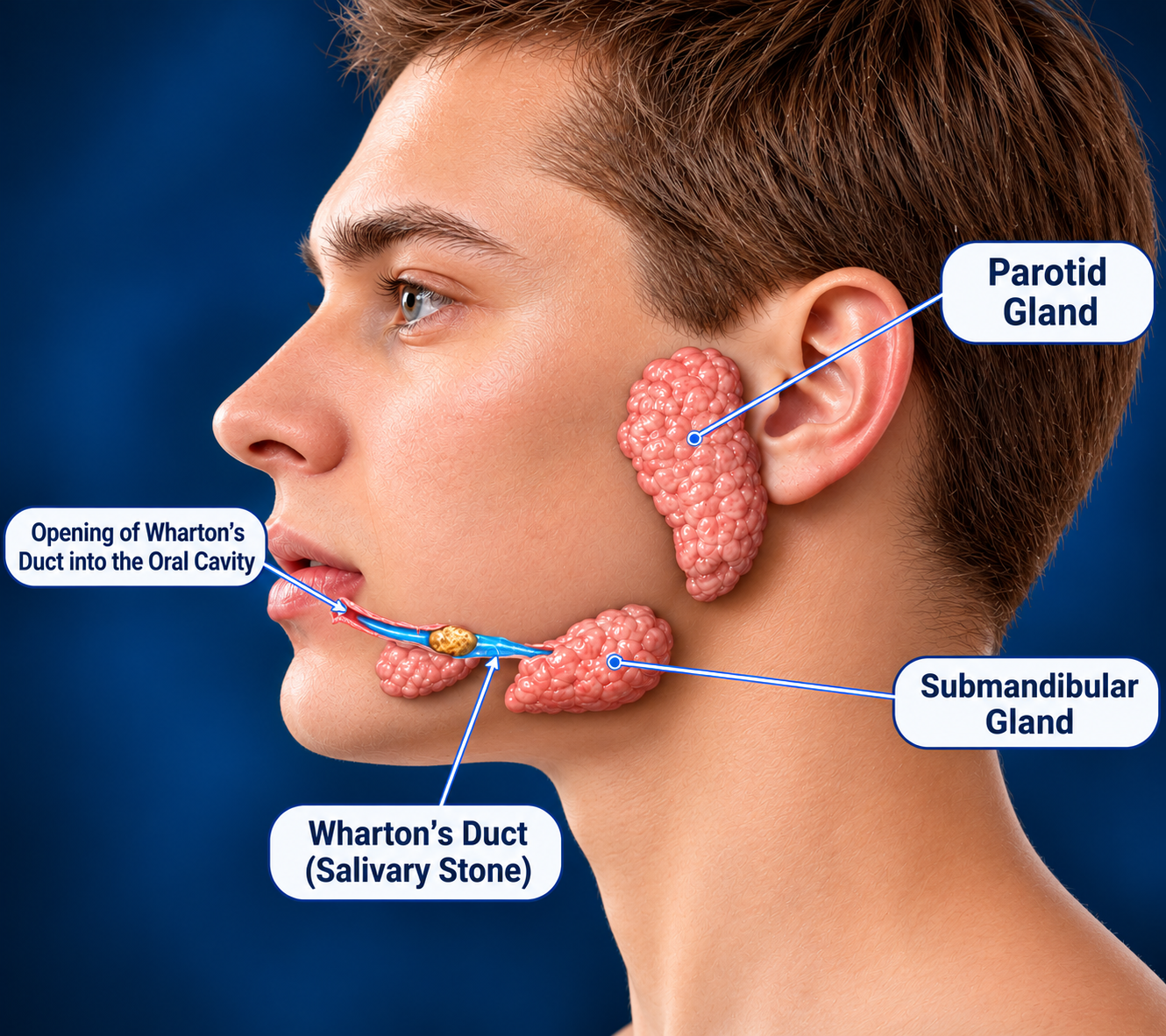
Diagram of the Salivary Gland and Its Duct
“A stone in the duct blocks saliva outflow, but the gland can often be preserved”
Can You Prepare for Treatment Before Coming to Russia?
Yes. Before your trip, it is best to contact the doctor. Send any medical records you have, so your situation can be assessed in advance. As a result, you arrive in Moscow with a clear plan already in place.
What Documents to Send in Advance
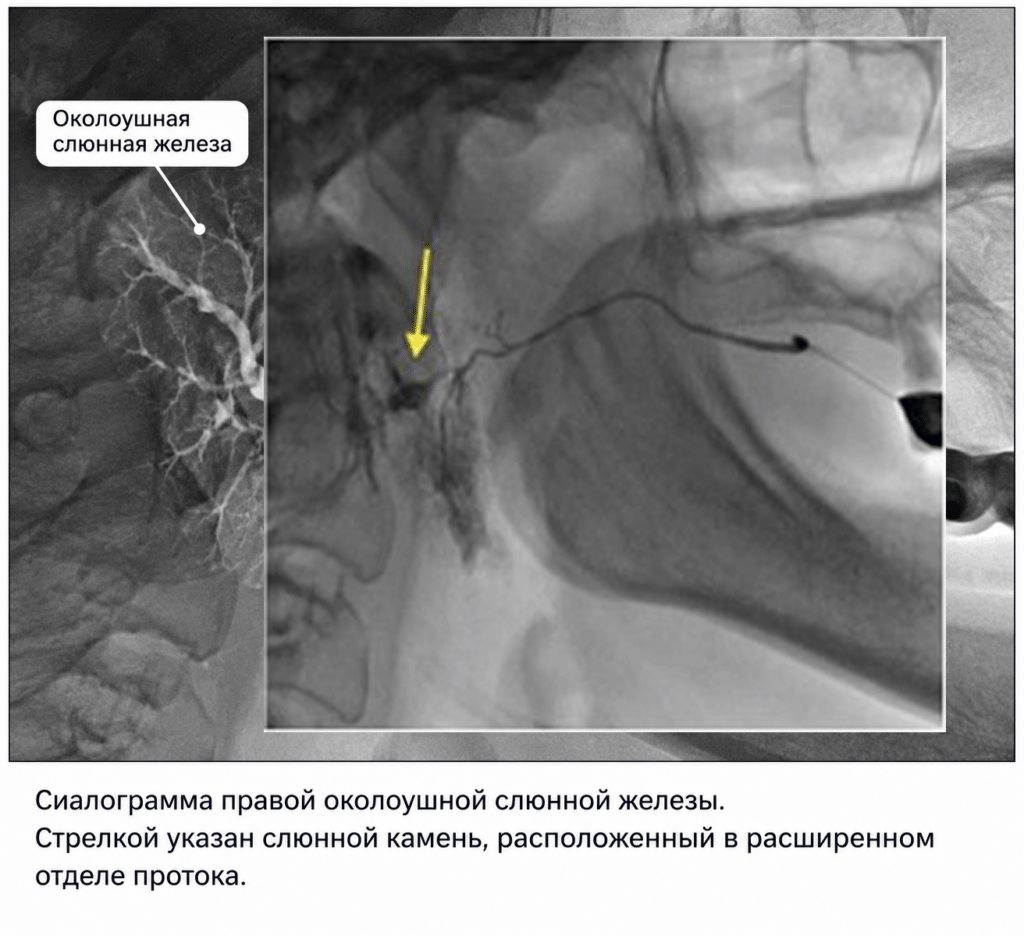
CT Scan
Shows the exact location and size of the stone
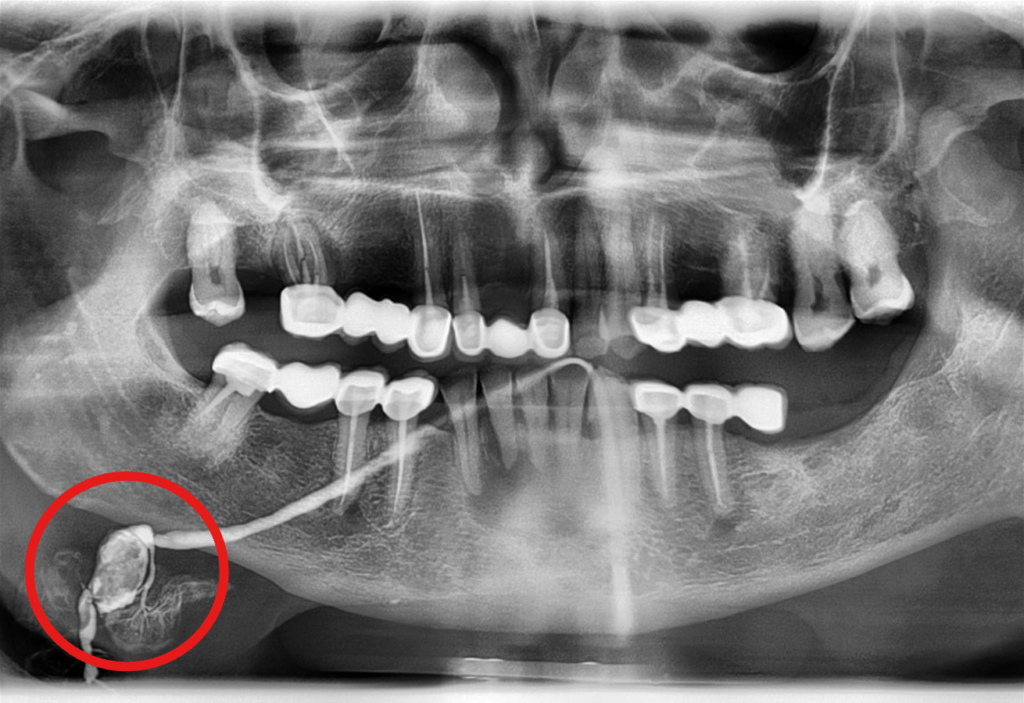
Sialography
Shows the condition of the duct system
CT and sialography are especially important. They often provide far more information than ultrasound alone. For example, CT shows the exact location of the stone. Sialography shows the state of the duct system. Both are especially valuable for planning a complex operation. However, ultrasound can still be a valuable initial diagnostic tool.
Also send:
- doctors’ reports;
- sialography results;
- MRI and ultrasound, if performed;
- results of any earlier tests;
- discharge summaries from previous operations;
- information about prior treatment;
- images and scans in their original quality, not photos of a screen.
Why It’s Important to Send Your Records in Advance
By reviewing your records before you arrive, the doctor can:
- review your medical records ahead of time;
- determine the likely location of the stone;
- assess the condition of the duct;
- understand what additional tests might be needed;
- discuss a possible treatment strategy in advance;
- shorten the time you need to spend in Moscow.
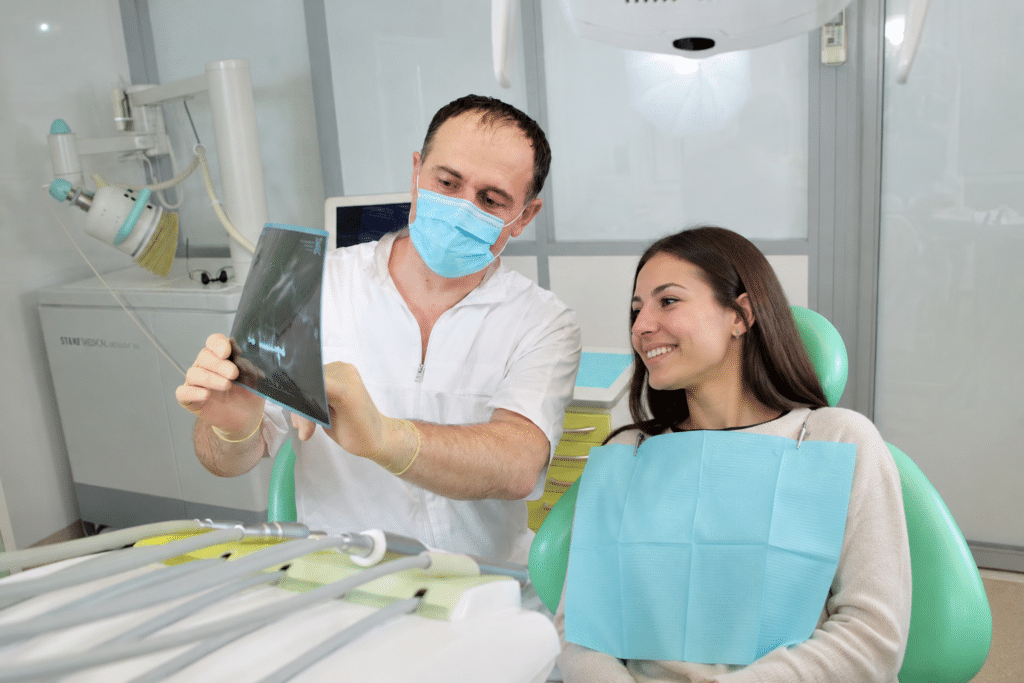
The Journey of a Patient from Another Country
“Some stages of treatment happen before you even arrive in Moscow”
How Long Treatment Takes
For patients from other countries, keeping trips to a minimum matters. Therefore, treatment is structured as a sequence of steps. Some of them happen before you even fly out:
- First, remote contact with the doctor;
- Next, sending your medical records;
- Then, a preliminary assessment of your situation;
- Later, arriving in Moscow;
- Afterward, the necessary workup;
- a consultation;
- choosing the treatment method;
- surgery, if indicated;
- Finally, follow-up after the procedure.
In suitable clinical cases, the workup and surgery can be organized within a short period. In some situations, the main stages take place within a single visit to Moscow. However, exact timing depends on the diagnosis and the extent of the procedure. Timing is therefore determined individually.
Salivary Stone Treatment in Moscow in a Single Visit
This matters especially for patients from abroad who cannot stay in Russia for long. In select cases, the medical records make it possible to determine an approach in advance. As a result, the workup and surgical treatment can be organized as compactly as possible. In some cases, the main procedures are even completed within a single day. However, this scenario is not always possible. It depends on the clinical situation.
Before You Arrive
You send your CT scan, sialography, discharge summaries, reports, and images. The doctor then reviews them and determines what additional tests are needed.
In Moscow
After you arrive, you undergo the necessary workup and consultation. Then the doctor confirms the treatment plan.
Surgery
Surgery can be performed during the same visit. However, this is possible only if the clinical situation allows it and there are indications.

Result After Surgery
“The goal of treatment is to remove the stone and preserve the gland”
Cost of Salivary Stone Treatment in Moscow
One of the reasons patients come to Moscow is cost. For many international patients, treatment in Moscow is significantly more affordable than in Europe.
In some cases, surgery in Russia costs several times less than comparable treatment in Europe. Sometimes it costs many times less. As a result, patients can receive specialized treatment at a significantly lower financial cost.
The specific cost is quoted after your medical situation has been reviewed.
What the Final Cost Depends On
- diagnosis;
- location and size of the stone;
- chosen treatment method;
- need for additional diagnostics;
- complexity of the operation;
- need for duct reconstruction;
- postoperative follow-up.
Why It’s Important to Contact the Doctor Before Your Trip
Do not buy tickets based only on a “salivary gland stone” diagnosis. Instead, send the doctor your medical records first.
A diagnosis on its own does not answer the main questions. For example, it does not show exactly where the stone is located. It also does not show the condition of the duct and gland. Nor does it show which treatment method will suit you.
What a Preliminary Consultation Can Tell You
- whether surgery is actually necessary;
- whether the gland can be preserved;
- which method might be used;
- what tests will be needed in Moscow;
- roughly how much time will be needed;
- whether treatment can be organized in a single visit.
How to Prepare for Your Trip
Follow these eight steps to cut down travel time and avoid unnecessary trips.
1. Contact the Doctor
First, call or message the doctor. Briefly describe your symptoms.
2. Send Your Documents
Next, send reports, discharge summaries, ultrasound and MRI results, and information about prior treatment.
3. Attach Your CT and Sialography
Also, if these tests have been done, send the images in their original quality.
4. Get Preliminary Feedback
Then the doctor will tell you what diagnostics and treatment may be possible.
5. Agree on a Visit Date
Afterward, agree on a visit date. The date is chosen based on the planned workup.
6. Arrive in Moscow
As a result, you arrive already knowing what to expect.
7. Complete Your Workup and Consultation
During your workup and consultation, the doctor will confirm the diagnosis. The doctor will then decide on the treatment method.
8. Undergo Treatment
Finally, surgery is performed when indicated.
Moscow
“Diagnosis and treatment — in one city, in a short time”
Patients from Europe and Other Countries
Patients from various countries come to Moscow for specialized care for salivary gland disease.
European Countries
This is for patients who were offered gland removal. It is also for those looking for an organ-preserving operation.
CIS Countries
A remote consultation helps plan the visit in advance.
The Middle East
Documents can be sent before departure, so the approach can be discussed in advance.
Other Countries
You can start from anywhere by sending your test results.
Why Preliminary Diagnostics Matter So Much
The choice of operation depends on exactly what the tests show. Specifically, the treatment method is determined by:
- the location of the stone;
- its size;
- the number of stones;
- the condition of the duct;
- duct dilation;
- the condition of the gland;
- the presence of inflammation;
- whether an organ-preserving procedure is possible.
The more complete the data, the more accurate the preliminary assessment. As a result, there is less uncertainty before your trip.
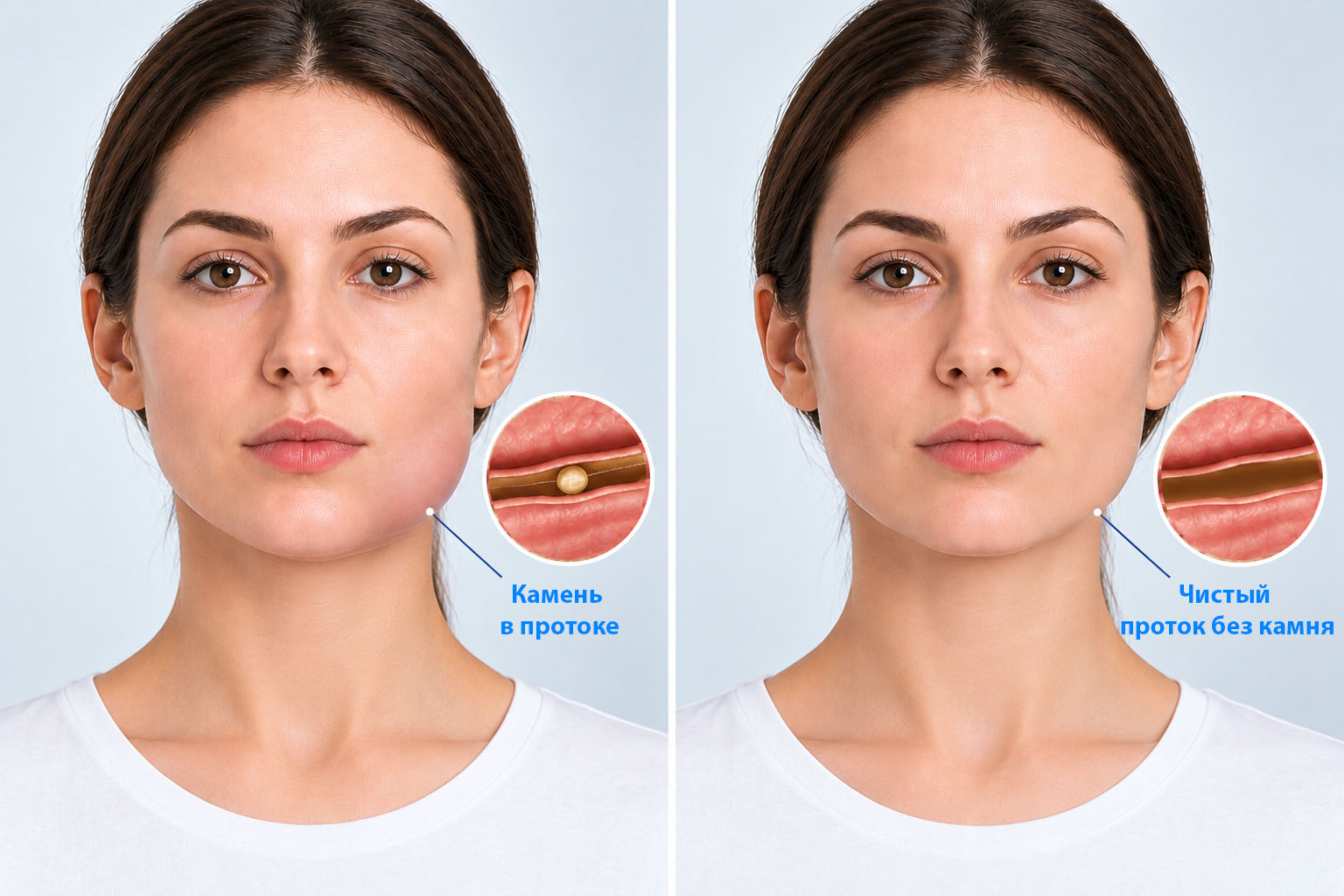
Salivary Stone (Sialolith)
“The size and location of the stone determine the choice of method”
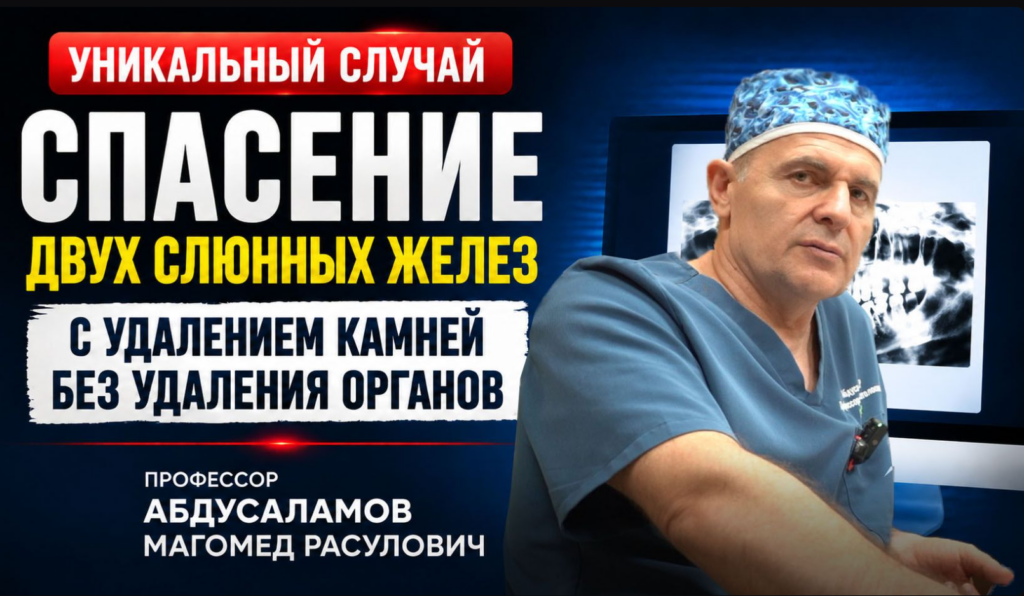
Magomed Rasulovich Abdusalamov
“Professor, maxillofacial surgeon”
Magomed Rasulovich Abdusalamov
Magomed Rasulovich Abdusalamov is a professor and maxillofacial surgeon. For more than 30 years, he has treated salivary gland disease. He has also performed more than 2,000 operations.
For him, a complex case is not a reason to remove the gland right away. Instead, it is an opportunity to preserve the gland and restore its function. Some patients come with the consequences of unsuccessful operations in other clinics and countries.
Read the doctor’s full profile, or see the certificates, patents and licenses page.
Main Areas of Work
- sialolithiasis;
- sialolithotripsy;
- removing stones from the salivary glands and their ducts;
- organ-preserving surgery — removing stones while preserving the gland;
- complex cases;
- duct reconstruction.
of work with salivary gland disease
operations, according to the clinic’s records
Frequently Asked Questions from International Patients
No. First, send the doctor your records. After reviewing your records, the doctor can see whether organ-preserving treatment is an option. The doctor can also see whether a trip is needed.
Yes. Send whatever you already have, such as ultrasound, reports and discharge summaries. However, CT and sialography are especially valuable for planning a complex operation. Therefore, the doctor may recommend having them done as well.
In suitable cases, the main stages can be organized within a single visit. However, whether this is possible is determined after reviewing your records. It is not guaranteed for every patient.
The exact cost is quoted after your medical situation has been reviewed. For many international patients, it is significantly lower than comparable treatment in Europe.
This cannot be guaranteed. The method depends on the position and size of the stone. It also depends on the condition of the duct and gland. However, the goal is to preserve the gland wherever possible.
If You’re Coming from Another Country
You may have been advised to have your salivary gland removed because of a stone. If so, you can send the doctor your test results before your trip. The doctor can then make a preliminary assessment of your situation. In some cases, there are methods for removing the stone while preserving the gland itself. However, this is not possible for every patient. The conclusion is reached after reviewing your records.